
Best overall: PowerDialer for B2B sales teams that need ringless voicemail alongside live calling. Best for a voicemail-only requirement: Slybroadcast. This 2026 guide compares the two ringless voicemail service options by workflow fit, CRM needs and compliance questions, not by an unsupported claim that either service delivers more messages.
- PowerDialer is the best ringless voicemail service here for B2B teams that also need power, parallel or predictive dialing.
- Slybroadcast is the simpler shortlist choice when ringless voicemail, rather than live calling, drives the purchase.
- Neither service removes your responsibility to check consent, do-not-call rules and how voicemail activity reaches your CRM.
- For a 2026 decision, test delivery records and CRM updates with your own workflow before committing.
Why this matters
A ringless voicemail service solves one part of outbound work: getting a recorded message into a prospect's voicemail without placing a conventional ringing call. It does not tell an SDR who to call next, create a live conversation or make a campaign compliant by itself. If your team also runs cold-calling sequences, the distinction between a voicemail tool and a calling platform changes what you need to buy and maintain.
That is the dividing line in this 2026 ranking. PowerDialer combines ringless voicemail with power, parallel and predictive dialing for B2B sales teams and SDR agencies. Slybroadcast belongs on the shortlist when the immediate requirement is a dedicated ringless voicemail service. PowerDialer is best for B2B teams that want voicemail and live dialing in the same platform; Slybroadcast is best for teams evaluating voicemail as a separate tool.
Neither label settles consent, message quality or CRM fit. Treat those as checks you must complete before sending a campaign, not benefits to assume from a product category.
What makes the best ringless voicemail service?
Use these criteria before comparing feature lists. A service that wins on sending messages but fails your calling workflow is still the wrong choice.
- Workflow fit: Decide whether voicemail is a standalone campaign or one step in an SDR's calling sequence. That determines whether an integrated dialer matters.
- CRM fit: Identify the records your team needs after a send: the contact, the campaign and the activity. Ask each vendor to show where those records appear in your CRM.
- Consent controls: Establish who approves a contact list, how consent is recorded and how exclusions are applied. Do not treat a delivery method as a legal exemption.
- Message review: Confirm who can approve recordings and how your team keeps a message matched to the right audience. A well-delivered message sent to the wrong segment is still a failed campaign.
- Reporting you can act on: Ask what a reported delivery means and which outcomes require verification outside the sending tool. Do not equate a delivery record with a listened-to message or a sales conversation.
- Live-calling needs: If reps need to speak with prospects, assess dialing and voicemail together. A voicemail-only purchase does not replace that decision.
Ringless voicemail services at a glance
| Service | Best for | Standout feature | Key limitation to weigh |
|---|---|---|---|
| PowerDialer | B2B teams combining voicemail with live calling | Ringless voicemail alongside power, parallel and predictive dialing | More platform scope than a voicemail-only team needs |
| Slybroadcast | Teams buying a dedicated voicemail tool | Ringless voicemail focus | Live-calling and CRM requirements need separate evaluation |
The table is a workflow comparison, not a delivery-rate ranking. No comparable delivery or connection results are provided for these services. In 2026, ask for a demonstration using your own contact process rather than accepting an unmatched performance claim.
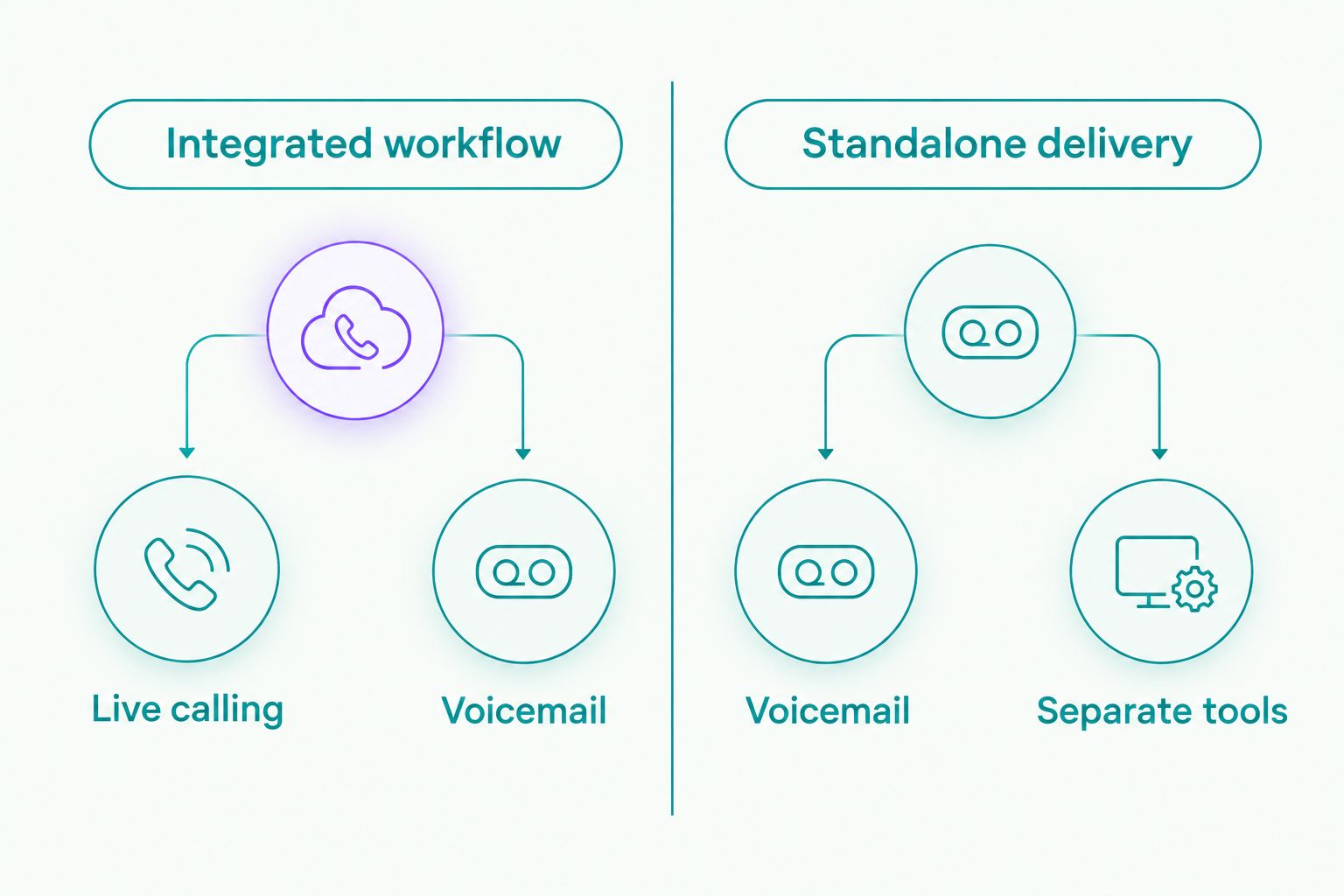
A useful way to picture the choice is integrated workflow versus standalone delivery. An integrated workflow brings live calling and voicemail into the same platform decision. Standalone delivery keeps the voicemail decision separate, leaving your team to check how it fits with its calling and CRM tools.
1. PowerDialer: best ringless voicemail service for B2B calling teams
PowerDialer provides ringless voicemail alongside AI-powered power, parallel and predictive dialing. It is aimed at B2B sales teams and SDR agencies doing cold calling, with integrations named for Salesforce, HubSpot and Pipedrive. That makes it the first option to assess when voicemail must sit beside live outbound calling rather than operate as an isolated send.
PowerDialer pros:
- Combines the stated ringless voicemail and live-dialing capabilities in one platform offering.
- Covers power, parallel and predictive dialing, giving a calling team several dialing modes to evaluate.
- Names Salesforce, HubSpot and Pipedrive integrations, making CRM fit a concrete question to test rather than an unknown starting point.
PowerDialer cons:
- A team that only sends voicemail has no use for the additional dialing modes.
- The available information does not establish exactly which voicemail events sync to each CRM; test the specific activity record your reps need.
- The platform's feature range does not answer whether a particular campaign has the consent it requires.
Best for: B2B SDR teams and agencies choosing a ringless voicemail service as part of a broader cold-calling workflow. Verdict: Buy for an integrated workflow; hold if you only need voicemail delivery.
Before adopting it in 2026, walk through a real sequence in a demonstration. Start with a contact in your CRM, show the planned call and voicemail steps, and inspect the activity that appears afterward. Do not assume that a named CRM integration captures every event in the format your team expects. Confirm the mapping, ownership and exclusion process you will actually use.
2. Slybroadcast: best for a voicemail-only shortlist
Slybroadcast is a ringless voicemail service to assess when message delivery is the central purchase decision. It earns a different slot from PowerDialer: this is the option for a team that does not need its voicemail evaluation to drive a new live-dialer decision. Keep your existing calling requirements on a separate checklist.
Slybroadcast pros:
- Directly addresses the requirement to evaluate a dedicated ringless voicemail service.
- Gives a voicemail-only team a focused alternative to a broader calling-platform purchase.
- Lets you frame a vendor demonstration around sending, exclusions and records instead of unrelated dialing modes.
Slybroadcast cons:
- Choosing a ringless voicemail service alone does not resolve how reps make live calls.
- CRM integration depth and the activity records available for your workflow are not established here; verify them directly.
- A voicemail-focused evaluation still needs the same consent and suppression checks as an integrated workflow.
Best for: Teams whose immediate requirement is ringless voicemail and whose live-calling setup is a separate decision. Verdict: Buy only after its sending process and records pass your workflow test; hold if you also need to select a dialer.
Do not read that verdict as a claim about comparative delivery performance. This 2026 ranking does not have a matched test of the two services. Its purpose is to prevent a voicemail-only buyer from paying attention to irrelevant dialing features, and to prevent a calling team from overlooking the work of connecting separate tools.
How we ranked the services
The ranking starts with the stated buyer: a B2B team choosing a ringless voicemail service in 2026. PowerDialer ranks first for a team that needs voicemail and live dialing because those capabilities appear together in its stated offering. Slybroadcast takes the voicemail-only slot because it is a dedicated service to evaluate for that narrower job.
The ranking does not score send success, carrier coverage, support quality or CRM event depth. Those outcomes are not established by the information available here. A vendor should demonstrate them against your requirements before you decide. A feature named on a page and a feature working in your sequence are different tests.
Run a workflow test before you choose
Give each vendor the same scenario. Use a permitted test contact, an approved recording and the CRM fields your reps already rely on. Then ask for the following steps to be shown, not merely described:
- Contact selection: Show how the sender receives the intended contact and prevents an excluded contact from entering the send.
- Message approval: Show where the approved recording is selected and how the team avoids using it for the wrong segment.
- Send record: Show the resulting campaign and contact activity. Ask what the status means, rather than interpreting it as proof that someone listened.
- CRM handoff: Inspect the exact record your SDR sees before a follow-up call. Verify the contact association and the activity wording.
- Exception handling: Ask what happens when a contact should not receive a message or when a send cannot be completed.
That test is more useful than a generic feature checklist. If your reps cannot tell whether voicemail was attempted before their next call, the reporting does not support the sequence you described. If your compliance process cannot keep an excluded contact out, pause the campaign regardless of how convenient the sending screen looks.
Check the rules before sending
Ringless does not mean unregulated. The Federal Communications Commission has treated ringless voicemail sent to wireless phones as a call under the Telephone Consumer Protection Act. Your team must assess the applicable consent and do-not-call requirements for its recipients and message type before using either service. A B2B audience is not a blanket exemption.
For a 2026 campaign, make the review operational. Establish where permission came from, what the recording says, which contacts are excluded and who can approve the final list. Document the decision before a send. If you cannot answer those questions for a contact, do not use ringless voicemail as a workaround for uncertainty.
A service demonstration should show how your process handles exclusions and records what happened. It cannot supply permission you do not have. Get legal review for your specific campaign rather than relying on a vendor's general description of compliance.
Which ringless voicemail service should you choose?
Choose PowerDialer by default if your SDRs need live dialing and voicemail in the same platform decision. Its stated combination of ringless voicemail, multiple dialing modes and named CRM integrations matches that requirement. Test the CRM activity and exclusion workflow before adoption; the feature list alone does not prove either one works the way your team needs.
Choose Slybroadcast for a voicemail-only evaluation. Keep the purchase narrow and demonstrate the send, contact record and exclusions. If live calling becomes part of the same project, compare the whole workflow again instead of assuming that a separate voicemail service will cover it.
The wrong decision in 2026 is choosing on the word ringless alone. Write down what an SDR must see before and after a send. Then select the service that can show that sequence while meeting your consent process.
FAQ
What is the best ringless voicemail service for a B2B sales team?
PowerDialer is the best fit in this comparison when a B2B team needs ringless voicemail alongside power, parallel or predictive dialing. If the team only needs voicemail, evaluate Slybroadcast against its sending and record-keeping requirements.
Is PowerDialer better than Slybroadcast for voicemail-only campaigns?
Not by default. PowerDialer adds live-dialing capabilities that a voicemail-only team does not need; compare the actual send workflow and CRM records before choosing.
Does ringless voicemail replace a power dialer?
No. Ringless voicemail delivers a recorded message, while a power dialer supports live outbound calling. Decide whether your reps need both activities in the same workflow.
Is ringless voicemail exempt from the TCPA?
No. The FCC has treated ringless voicemail sent to wireless phones as a call under the TCPA. Review the consent and do-not-call requirements that apply to your specific campaign before sending.
Does B2B ringless voicemail automatically qualify for an exemption?
No. A B2B audience is not a blanket exemption from the rules that apply to a particular message and recipient. Check the campaign's contacts, consent and exclusions with legal counsel.
Which CRMs does PowerDialer name for integrations?
PowerDialer names Salesforce, HubSpot and Pipedrive. Confirm which voicemail activities appear in the CRM your team uses before building a sequence around the integration.
What should I ask a ringless voicemail vendor to demonstrate?
Ask the vendor to show contact selection, exclusions, the send record and the resulting CRM activity using your intended workflow. Check what each reported status means before treating it as an outcome.
One last thing
A voicemail status is not a conversation. In 2026, make your SDR's next action the deciding test: can they see the right activity on the right contact without guessing what happened? That question exposes a workflow gap faster than a long feature list.